
Forums › Forums › Islamic Sharia › Is Wearing Hijab An Obligation What Makes Ghamidi Sahab's View Valid?
-
Is Wearing Hijab An Obligation What Makes Ghamidi Sahab's View Valid?
Posted by Sara Ahmad on December 30, 2025 at 4:59 amI’ve watched the whole series of his view on hijab and parda, but I just came across an ayah from quran in surah Noor where allah mentions elderly ladies bear no sin for exposing their hairs, it conflicts me, I don’t personally wear hijab all the time, and I want to make sure if it is Haram, or what is there in Quran, kindly help me out on this
Zohaib Tariq replied 1 month, 1 week ago 5 Members · 25 Replies -
25 Replies
-
Is Wearing Hijab An Obligation What Makes Ghamidi Sahab's View Valid?
-

Dr. Irfan Shahzad
Scholar December 31, 2025 at 5:27 amThe verse you mentioned does not say that elderly ladies can expose their hair. It says they can expose their zeenat. It means that other woman should cover their zeenat. There is no mention of hijab there.
-
Rabia Ali
Member December 31, 2025 at 5:34 amWhat if there is not zeenat on hairs? Why it is said that if a women is doing zeenat she can show only hands, feet and face… why hairs are including when she is doing zeenat?
-
Dr. Irfan Shahzad
Scholar December 31, 2025 at 11:13 pmThe verse does not specify face, hand, or head. It is our habit of dressing that tells that face and hands are not covered. Covering is about Zeenat. If there is no zeenat on the head, the verse does not require it to be covered. Muslim women cover their head as a cultural norm.
-
Sara Ahmad
Member January 6, 2026 at 5:41 amWhat is considered zeenat for hairs, what kind of zeenat are allowed to be exposed? There are many things a person can wear including hats or clips or jewelry and so on, I don’t usually wear hair scarf and my concern is if I wear anything on my hairs would I need to cover my hairs? How about styling your hairs, does it also count as zeenat? I also read a narration where hazrat qatadah r.a asked hazrat ayesha r.a O mother of believers tell me about the character of prophet (saw) and she (r.a) replied , have you not read the quran his character is Emobiment of Quran, so if that is the case doesn’t the view of ghamidi sahab is against the rasullallah saw, since his wife’s (r.a) and mothers of believers never uncovered their hairs and he (saw) had beard and did many things we don’t do, kindly explain it better
-
Dr. Irfan Shahzad
Scholar January 6, 2026 at 10:53 pmWhatever is considered Zeenat is Zeenat. Zeenat is something external beautification applied to the body or hair. So styling your hair is not its beautification; however, if you dye it, it is beautification or zeenat, just like Mehndi on hands.
The women would cover their heads as a cultural norm, not as a religious command. We need to differentiate between cultural norms and religious commands.
The wives of the Prophet were given special protocols to keep them aloof from other people. Therefore, the verse that addresses them excludes other women:
يَا نِسَاءَ النَّبِيِّ لَسْتُنَّ كَأَحَدٍ مِّنَ النِّسَاءِ ۚ إِنِ اتَّقَيْتُنَّ فَلَا تَخْضَعْنَ بِالْقَوْلِ فَيَطْمَعَ الَّذِي فِي قَلْبِهِ مَرَضٌ وَقُلْنَ قَوْلًا مَّعْرُوفًا ﴿٣٢﴾ وَقَرْنَ فِي بُيُوتِكُنَّ وَلَا تَبَرَّجْنَ تَبَرُّجَ الْجَاهِلِيَّةِ الْأُولَىٰ
Wives of the Prophet! You are not like common women. If you fear God, do not adopt a soft tone [with these people] so that he who has an ailment in his heart should have any false hope and speak to them in the conventional way.
Not only the prophet but all the pepole, whether they were believers or disbelievers, had a beard. This is again a cultural thing. The prophet did not include it in the content of religion.
As Muslims, we are bound to follow the Prophet. If we do not accept anything binding upon us, we are no longer Muslims. But we do not follow blindly; we try our best to understand what religion is and what it is not.
-
Zohaib Tariq
Member January 13, 2026 at 10:23 amIn case of beard ghamidi sahb explained that “Allah has made people different: some can grow a beard, and some cannot.” But according to him eating with right hand is Sunnah which must be followed one can say that just like beard Allah has created some human beings left handed too then why making something a part of religion when people with different abilities exist
Secondly while translating or giving his point of view he says that illa ma Zahra mean hands face and feet if different cultures are allowed to interpret it their own way then why he categorizes it?
if women can use other forms to cover their chest like a baggy shirt or a coat then can she wear something over it as the chest isn’t prominent it can be said that some cultures allow use of adornments over chest
Lastly Quran is universal then why it only addressed to only specific people in case of hijab it says that draw your veils over your chest but how is it possible that everyone on earth at that time used a headscarf
-
Dr. Irfan Shahzad
Scholar January 14, 2026 at 1:24 amThe Holy Prophet did not declare keeping a beard as part of the Sunnah; therefore, it cannot be made obligatory.
A left-handed person may eat with the right hand; this is not a major issue. In modern Western etiquette, people often eat with the left hand even if they are right-handed. However, one who does not have bread cannot grow it.
The Sunnah of eating with the right hand serves as a reminder that God will give us our record of deeds in our right hand.
God has not specified exactly what falls under the category of “illa ma zahara”; therefore, it is naturally left to human judgment. As with many matters, some aspects are universal while others vary. The face and hands are meant to remain exposed, so any adornment on them will also remain visible.
A woman’s chest is universally regarded as a private part. Exposing it, or its adornment, is generally considered less appropriate than covering it and concealing its adornment, although some cultures permit it.
Covering the adornment of the chest is required, and one method for doing so is mentioned in the Qur’an. If the same purpose is achieved through other means, it is also acceptable.
The Qur’an sometimes presents a general principle and at other times provides a specific application of that principle, and we figure out the principle. The Quran does it to make us think and discover; in this way, it satisfies intelligent people and lets them join in the quest for knowledge.
-
Zohaib Tariq
Member January 22, 2026 at 4:00 amHow can we know what is in Sunnah and what not.
Whenever ghamidi sb explained the command to cover zeenat he always said “whenever a woman is adorned then except hands face and feet she shouldn’t show anything else”
He never said that it varies from culture to culture…
-
Dr. Irfan Shahzad
Scholar January 29, 2026 at 3:48 amThe expert in Islamic Sciences, on the basis of their knowledge and argument, tells what the sunnah is and what is not a sunnah.
You may know their argument and then decide.
Exemption of face and hand is universal. The cultural differences are considered with respect to other details while determining the limits of covering and exposing other body parts.
A colourful veil to cover the chest is fine, because it is a usual beautification which is not supposed to be covered, howeover, if it is adorned, it won’t serve the purpose.
-
Zohaib Tariq
Member January 28, 2026 at 4:27 amHow can we know what is in Sunnah and what not.
Whenever ghamidi sb explained the command to cover zeenat he always said “whenever a woman is adorned then except hands face and feet she shouldn’t show anything else”
He never said that it varies from culture to culture…And if the cloth used to cover chest is printed or decorated would that be impermissible to use?
-
-
Sara Ahmad
Member January 7, 2026 at 5:58 amBrother, I get it external beautifications are zeenat, I asked what zeenat are asked to kept hidden, as per religion doesn’t obligate it on us to wear hijab according to what you said, then if I do not wear hijab then my zeenat (could be ear rings, or any kind of jewellery or some head accessories or scarf or even make up ) will be left open, now does it make me sinful,? It is complicated, since what I’ve understood after listening to ghamidi sahab’s series on pardah, was that you can leave open the accessories unless it is a necklace and there r 3 stages of pardah and anyone on the first stage or the after is not doing anything wrong everybody has their own journey practicing Islam, now I’m wondering, anyone who is not doing complete pardah, maybe for women, who are not covering up as much as women who are hijabis, but they are mindful of covering up properly enough where their private parts are not exposed, and the parts close to their private parts, are they sinful, kindly elaborate it properly on this part aswell,
-
Rabia Ali
Member January 7, 2026 at 6:50 amIn the verse, the expression “illā mā ẓahara minhā” is often interpreted to mean those parts of the body that are customarily visible, such as the hands, face, and feet. However, some people argue that in contemporary practice, women also leave their hair uncovered, while ensuring that the chest area remains properly covered. From this perspective, the phrase may be understood to mean that if a garment is placed over the jewelry worn on the chest, yet some part of it remains visible through the clothing, then this is not something over which a woman has control.
I think it is still so complicated.
-
Sara Ahmad
Member January 9, 2026 at 3:55 amIf that is the case that you are supposed to hide all external beautiful, make up would not be allowed as well then in front of non mahrams
-
Sara Ahmad
Member January 11, 2026 at 4:06 am@Dr. Irfan shahzad,
Brother answer?
-
Rabia Ali
Member January 11, 2026 at 4:15 amIf I am not mistaken, just as decorative clothing falls under the category of “except what normally appears” (illā mā ẓahara minhā), the same applies to makeup—it can also be included in that category. The real issue, however, is the chest area. Allah has made this very clear: the chest must be covered. This means that any jewelry worn on the chest should also be concealed. The reason is that when jewelry is worn on the chest, it can naturally draw the attention of non-mahram men toward that area. In my understanding, this is why it has been emphasized that a cloth should be placed over the chest—especially if one is wearing jewelry there.If I am mistaken, please correct me.
-
Dr. Irfan Shahzad
Scholar January 11, 2026 at 9:51 pmIt appears that there is some confusion between the concepts of ʿAwrah and Zeenat. Covering one’s private parts and the areas surrounding them is a separate matter from concealing zeenat. A person is required to cover all zeenat—such as makeup and adornments—except for what is customarily left visible. What may remain visible is determined by cultural norms. Generally, the zeenat of the face and hands is left uncovered and exposed. However, adornment on the chest area should be covered. Earrings are considered part of facial adornment and may remain visible.
The head itself is not considered a private part, so it may remain uncovered if it is not adorned. If it is adorned, then whether it should be covered depends on cultural expectations: in some cultures it should be covered, while in others it may remain uncovered.
-
Rabia Ali
Member January 12, 2026 at 3:20 amWhat you mean is that if, in a certain culture, covering the head is customary, then any adornment on the head should also be covered. However, if in a culture covering the head is not customary, then whether there is adornment on the head or not, it may be kept uncovered.
-
Dr. Irfan Shahzad
Scholar January 12, 2026 at 10:58 pmRight.
-
Dr. Irfan Shahzad
Scholar January 12, 2026 at 10:59 pmThe dress is zeenat, no matter whether it is adorned or not, it can also stay exposed.
-
-
Rabia Ali
Member January 15, 2026 at 4:15 pmSalam
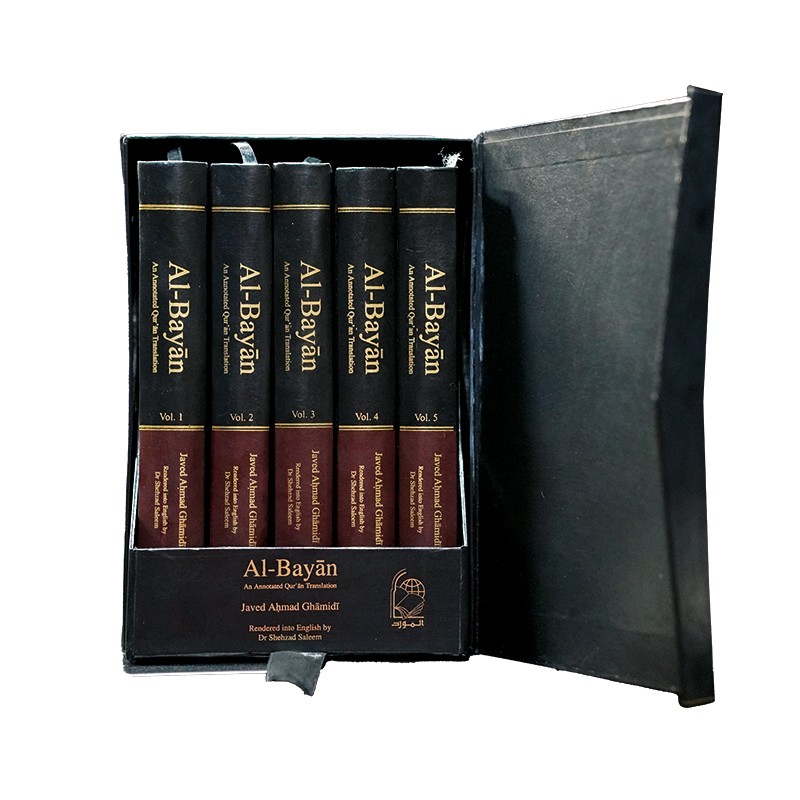
English translation of Al Bayan is available in pakistan?
-
Umer
Moderator January 17, 2026 at 8:44 amYes, it can be ordered online from Al-Mawrid Bookstore:
https://al-mawrid.net/eshop/en/text-books/149-al-bayan-english-complete-set-gift-box.html
al-mawrid.net
Bayan,Javed,Ghamidi,Shehzad,Quran,Exegesis,Al-Mawrid,
Bayan,Javed,Ghamidi,Shehzad,Quran,Exegesis,Al-Mawrid,
-
-
Dr. Irfan Shahzad
Scholar January 15, 2026 at 9:54 pm -
Sara Ahmad
Member January 24, 2026 at 2:03 amIf a Jewellery is on neck but not hanging till chest, would it be oke? Also, I can’t understand the concept of cultural norm, for example some people (like me) lives in a foreign country, and not in Pakistan even though I was born and lived in Pakistan for a while, what cultural norm am I supposed to follow, for example if in a culture, could be Malaysia or uae or even in Pakistan, people wear clothes that exposes their shins or arms or neck and sometimes a little part of their stomach but they cover their private parts properly, so what would be the ruling for. those people? If a person is covering their private parts properly but doesn’t cover all of their body, would they be sinful? And what norm should anyone be following, there are many according to where you live and where you might live in future, and also I want to clarify what kind of zeenat of hairs is allowed or not allowed to. exposed, and hairs are not a private part so why it’s zeenat is required to be hidden?
-
Dr. Irfan Shahzad
Scholar January 26, 2026 at 11:21 pmThis is where a person has to decide, not a scholar. You would decide what cultural norms you would follow. God has told what to hide. Now the lines between the forbidden and allowed have to be drawn by the people. For different people, they are different. God has no intention to see everyone follow the same norms. Private parts should be covered. And if there is a zeenat, it should be covered when it is on the chest. The rest is your decision.
-
Zohaib Tariq
Member January 30, 2026 at 1:04 pmWhat’s the difference between adorned and beautified? Aren’t both the same then why there is an exemption for printed or colorful veil while not for adorned one when both are external beautifications



Sponsor Ask Ghamidi


